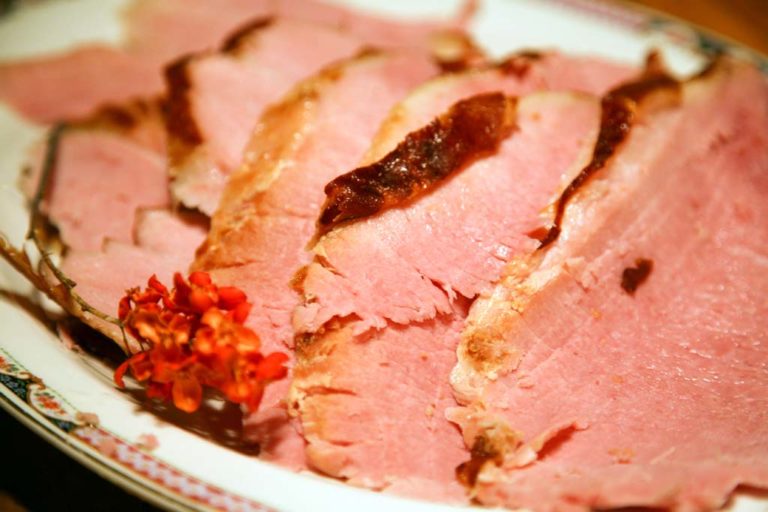
Chef's notes:
As if pork wasn’t tasty enough, some genius a long time ago figured out how to make it better. At the time, the process of curing pork was necessary to keep the meat from spoiling, thereby allowing people to store large quantities of meat for months at a time. These days our meat comes to us frozen, cold, or canned. And we don’t have much need for curing, except that we enjoy the taste. If I could, I think I would eat ham at every holiday: Easter, Christmas, Thanksgiving, Memorial Day, Independence Day, maybe even Presidents Day or Halloween. Trick or ham?
Ingredients
- 10-15 # bone-in ham
- 2 onions, sliced
- 2 T whole cloves
- 1 cup honey
Ham Recipe: Whole Bone-in Ham Spiked with Cloves and Baked on a Bed of Onions with Honey
- Choose a ham to bake. For this article I chose a wet-cured, bone-in ham. Hams are made by curing the butt or some other part of a pig. There are two ways to cure a ham—wet or dry. Dry-cured hams are rubbed with a mixture of salt, sodium nitrite, and/or sodium nitrate. They are then aged dry and sometimes smoked. These are the hams you see hanging from rafters and whatnot. They include all the prosciuttos, Serrano, iberico, Virginia, York, Westphalian, Ardennes, Jinhua, and Elenski ham. Wet-cured ham is submerged in a brine of salt, sodium nitrite, sodium nitrate, and sometimes smoke flavoring. These hams are also sometimes injected with the brine.
- Prep the ham to be baked. Heat the oven to 350 degrees F, and move the oven rack to the next to bottom position. Cut through the fat on the outside of the ham in lines perpendicular to one another, making little squares. This helps render the fat and gets flavor deeper into the ham. Ham is already very flavorful, but there are some nice complementing flavors that can be added. Some classic flavors include cloves, honey, brown sugar, cinnamon, mustard, ginger, and allspice. For my ham, I spread honey around the outside and then dusted it with some allspice and cinnamon. I also chopped some onions for the base of the pan.
- Bake the ham in the oven. Once the oven is up to heat, cover the ham with aluminum foil and place it in the oven. The duration of cooking will depend on the size and whether or not there is a bone inside. Set the timer for 2½ hours and put the ham in. After 2½ hours, use a digital thermometer and check the internal temp. You are looking for an internal temperature of 140 degrees F. The best way to monitor the internal temperature of the ham as it rises is with a digital thermometer with a detachable probe that is left in the ham as it cooks. This way, once the internal temperature reaches the desired reading, you can confidently take the ham out of the oven.
- Rest the baked ham. After the ham reaches 140 degrees F, take it out of the oven and set the roasting pan on a hot pad. Let it sit there, covered, for 30‒40 minutes to rest. The juices inside the meat are bubbling, and if you cut it open now, the juice would run out, leaving an extra dry ham roast. By letting the meat rest, the juices cool a little and stick closer to the meat. When the meat has sat for 30‒40 minutes, take it out of the pan and slice it up for serving. The great thing about ham is the leftovers. Leftover meat is great for sandwiches or a midnight snack. And if you cooked a ham with bone, you have some tasty soup to look forward to.
- Ginger-Snap and Bourbon Crusted Ham. Ham with a crust of ginger snaps is quite popular these days. For that, cook the ham covered at 250 degrees F until the internal temperature reaches 130 degrees F. Then take it out and turn the oven up to 350 degrees F. Remove the skin and fat from around the outside of the ham, and dry the ham with a paper towel. Coat the outside of the roast with mustard. Crumble up some gingersnaps and mix them with an equal part of brown sugar. Put the mixture onto the outside of the ham like a crust. Using a spray bottle, spritz the crust with bourbon to moisten it and help it stay on. Put the ham back in the oven uncovered and cook until it reaches 140 degrees. Enjoy!
Tips & Tricks
- If you cut the ham in half before cutting it to serve, it will be easier to slice thinly.
- Save the bone. Ham bones make excellent soup stock!
- Use a thermometer in your oven. Oven thermostats are often inaccurate.
- Don’t worry if some of the fat gets a little crispy; the meat should be fine. Plus, some of us like crispy pork fat.
- Use a digital thermometer to check the internal temperature of the ham. If the ham has a bone, take the temp near it.
Raisin sauce recipe
- 2 cups raisins
- 3 cups water
- 1 cup sugar
- 1 tsp salt
- 4 T rum
