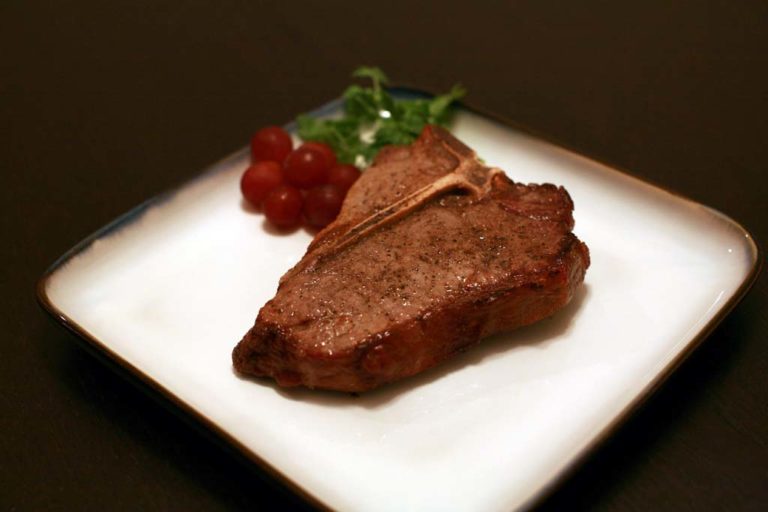
Chef's notes:
The T-bone is a steak cut from the vertebrae of the loin section of a beef cow. Each vertebra is sawed in half along the spinal column, and in turn, each half is sawed in half along the transverse process. So from each vertebra, we usually get four T-bones, two per side. The round opening on the top of the T-bone is the vertebral foramen, which is the hole that the spinal cord runs through. That should give you some idea of the location of the T-bone steak.
A T-bone is actually a combination of two of the most tender pieces of meat found on a beef cow: the New York strip (strip loin) and the tenderloin (filet mignon). The T-bones get bigger the farther to the rear of the beef cow that you go. And once the tenderloin portion of the T-bone reaches a thickness of 1.25 inches, the cut changes from a T-bone to a Porterhouse.
Ingredients
- 2 dry-aged beef T-bones
- Sea salt
- Black pepper
- Safflower oil
Broiled Dry-Aged T-bone Steak: Seasoned with Sea Salt and Black Pepper
- The first step to broiling T-bone steaks is choosing your steaks wisely. The steaks you see to your right are two dry-aged T-bones. The nice thing about dry-aged beef is that the water weight is reduced through evaporation, which concentrates the beef flavor. The natural enzymes in the meat also help to tenderize the meat. Meat is not often dry-aged over 28 days, but occasionally you will find it that way. If you have never had dry-aged beef, you are in for a treat.
- Before broiling your T-bones, take them out of the fridge and let them come up to room temperature. With high-quality meat, it will be a good idea to keep your seasonings simple. I am assuming, of course, that you bought these steaks because you like the taste of meat? Well, in that case, apply to taste: sea salt, fresh cracked black pepper and a high-flashpoint oil like safflower or vegetable. A flashpoint is the temperature at which something combusts. So a high flashpoint will ensure no burnt oil taste.
- Heat the broiler up for 5-10 minutes before putting your T-bone steaks in the oven. Gas broilers will be hot quicker than electric broilers. Look to make sure you will be able to position the steaks directly under the highest heat, as in the picture to your left. The electric broiler is most commonly laid out in this fashion. Once the broilers are glowing red, put your broiling pan under the broiler. Leave the oven door open a crack. This helps to keep the broiler thermostat from turning the broiler off because the oven is too hot.
- After about five minutes, check the T-bone steaks to see how they are browning. If you think they are ready to be flipped, pull out the rack and use a pair of spring-loaded tongs to flip them over. Then place the broiling pan back under the broiler as it was before. Continue to broil the steaks until they are done to your liking. Using time as a judge for doneness is not a good way to cook meat. Instead, use temperature as a guide for the doneness of the meat. Rare meat should be 120–125 degrees, medium should be 140–150 degrees, and well done should be around 160–170 degrees. Before serving the steaks, remember to let them rest for a few minutes in an elevated position, like on a rack, and covered loosely with aluminum foil. The rack keeps them from sitting in their juices.
Tips & Tricks
- The broiler can be a tricky thing to work with—as my roommate proved on his latest attempt at broiling salmon. I had no idea salmon was flammable. Epic fail.
- The main thing is to keep an eye on the distance between the heat source and the target food. If it’s too close, the outside will burn before the inside is cooked. If it’s too far away, you will end up baking it instead of broiling it. Smoke is almost sure to occur either way, so open a window and turn on a fan or a hood vent if you have one. If broiling is new to you, pull up a chair and watch with the oven door open as your meat cooks under the broiler. That way, you can adjust things as necessary. I have faith in you and I know you can do this.
