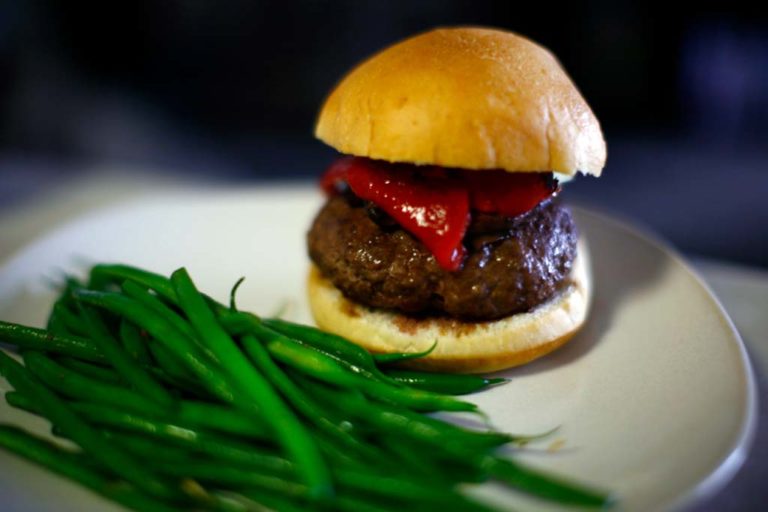
Chef's notes:
I remember when I was very young my family and I were in Wall Drug, South Dakota, home of the free glass of ice water and the most ridiculous assemblage of touristy crap I have ever seen. We were either on our way to or from a family reunion. We were driving in a caravan of vehicles—a couple RVs and a couple vans. Anyway, we were having lunch at some tourist trap cafe and I saw that there was a buffalo burger on the menu. So I ordered it. I was just a little kid, but I had seen buffalo and naturally wondered what they tasted like.
The burger was not what I expected. It was cooked all the way through, which meant it was dry. But I was OK with that since I drowned it in ketchup anyway. But the meat tasted gamey to me. As a child in northern Minnesota, I was raised on venison, so that shouldn’t have bothered me. But it did. I couldn’t finish it.
Ingredients
- 2# ground buffalo
- 1 Tbsp sea salt
- 1 tsp cayenne pepper
- 1 tsp black pepper
- Roasted red pepper
- Sliced onion
- Mushrooms
- Feta cheese
- Horseradish
- Bleu cheese
Pan-Fried Homemade Buffalo Burger
- Mix up the ground buffalo with your preferred herbs and spices. I purchased 2 pounds of fresh ground buffalo from a local co-op. I was actually a bit surprised that they had fresh available. Anyway, for my ground beef mixture, I added 1 Tbsp sea salt, 1 tsp cayenne, and 1 tsp fresh cracked black pepper. I could have added a bit more of each as it turned out, but I like salty stuff. Next, I just mixed the meat by hand until all the spices were evenly mixed. If you mix it too much, the meat ends up being kinda stringy.
- Shape the ground buffalo mixture into patties. If you like big fat patties, make them fat. The meat will shrink a little, though, so your patties may end up looking like meatballs if they are too big. If you have difficulty making consistent sizes, try dividing the meat before shaping the patties. Or you can use an ice cream scooper to keep consistent sizes. To make a good patty, ball it up in your hands and begin to flatten it down. Using your thumb, give the patty a smooth edge to keep it from falling apart.
- Heat up a frying pan on medium heat with some butter and fry the first side of the patty. You can use any fat to fry burgers; I just like the taste of butter. If you do use butter, make sure to let it cook a little until it browns just a tiny bit. The reason for this is that butter is 80 percent water, and you want to cook out as much as you can before cooking in it. Also, don’t cram too many burgers into the pan at once. In the photo to the right, there are six burgers. I should have only done four at a time in a pan that size. Too many burgers and the pan gets full of liquid, which debilitates the frying action. Frying creates caramelization on the burgers through a process known as the Maillard reaction. Caramelized flavors are quite delicious, so you don’t want to lose them.
- Flip the buffalo burger over and cook the other side. After 4 minutes or so the meat should be nice and brown on the bottom, and it’s time to flip it over. It is also difficult to flip burgers in a pan with too many patties in it. The length of cooking time will depend on how thick your patty is, how hot the stove is, and how you like your burgers. After cooking the other side for 4 minutes, use a digital thermometer to test the internal temperature of the patty. The minimum temperature for your ground meat to be considered safe is 155 degrees F. At this temperature the burger will still be very moist inside and a little pink as long as you take it off the heat at 150 to 153 and let it coast up to 155, which it will naturally. If you want to cook it below that temperature, go for it. It’s up to you.
Tips & Tricks
- In the restaurant industry, if a place makes their own patties, chances are they are smashing portioned scoops between two plates. It works really well to cover the plates with plastic wrap before smashing them. Or use two pieces of parchment paper, one on either side. You may still have to round out the edges. But it is a nice way to make consistent patties.
- Broiling or grilling is probably the preferred method of cooking burgers. For that, use the same techniques as here except don’t put the butter on the grill! With grilling it is important not to touch the burger once you have put it on the grill until that side is done. To flip, do it quickly and use a good metal spatula. If you are getting a lot of flare-ups, lower the heat. The broiler will be similar except you will have to bend down to see how the burgers are cooking. I almost always broil on high. If it is too hot, I can lower the rack. High heat just gets the outside the way I like it: nice and brown!
